
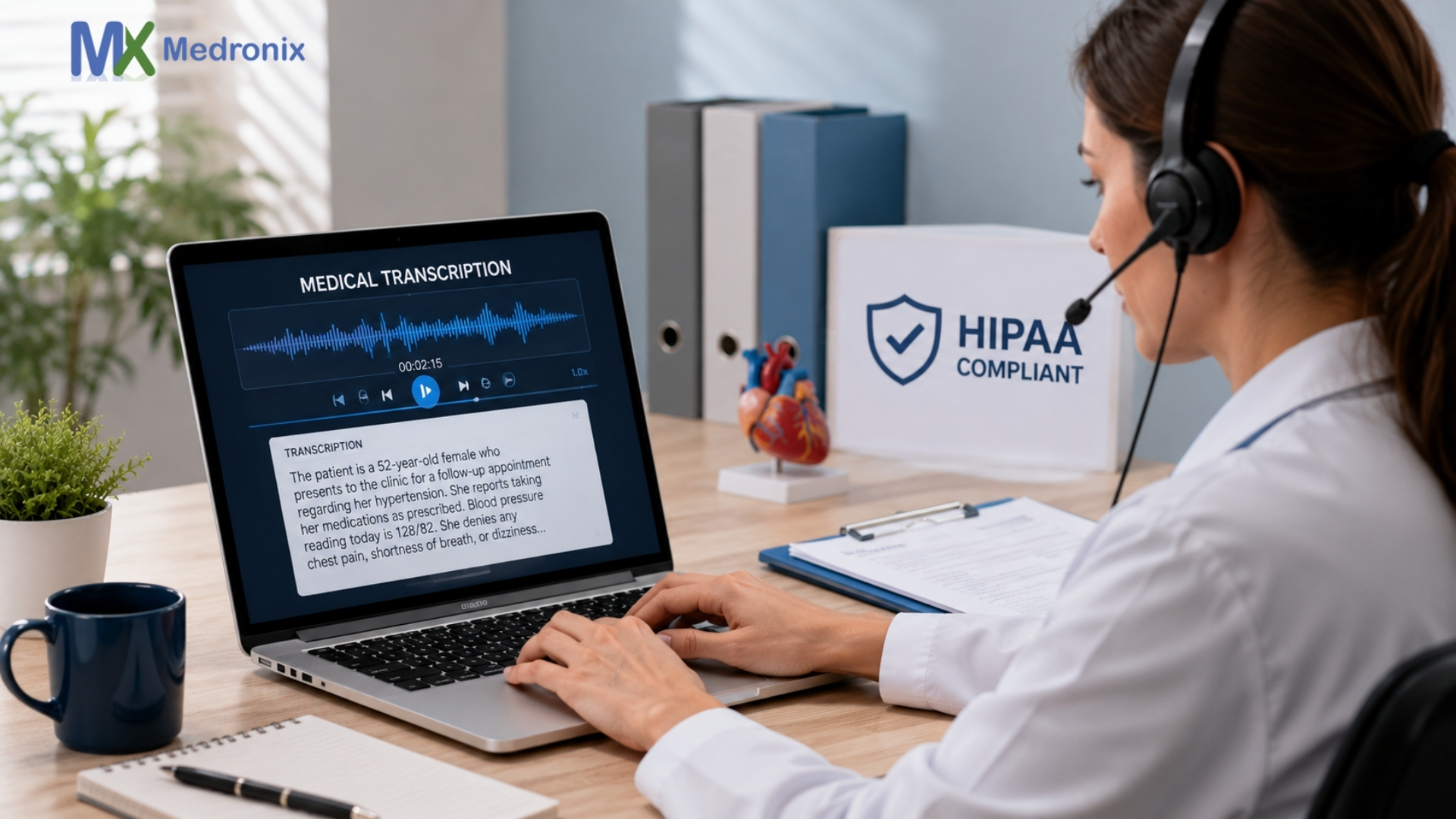
Doctors didn’t spend years in school just to type notes at night. Ask any physician what eats up their evening, and documentation almost always tops the list. But note-writing now eats into hours that should go to patients, family, or rest. That’s the real problem medical transcription services solve. They turn spoken words into clean, tidy records. The doctor stays focused on care, not a keyboard.
Here’s the catch, though. Not every provider treats patient data the same way. Some cut corners on safety. Others use raw AI output with no human check, and that sounds fast until a wrong drug dose slips through. Picking the right partner means knowing what makes a service safe and worth trusting. That starts with the rules around patient privacy.
Patient records hold some of the most sensitive data any business will ever touch. The rules aren’t just paperwork, they’re the whole base of trust. HIPAA compliant medical transcription services lock down files during upload and while they sit in storage. They sign a Business Associate Agreement, or BAA, with every client. Staff take privacy training each year, not just once at hiring.
A data breach does more than cause a bad headline. Federal fines for HIPAA slip-ups can reach into the hundreds of thousands of dollars per case. Add in the loss of patient trust, and the cost climbs even higher. Some practices never fully recover their reputation after a public breach, even once the fine gets paid and the audit closes.
Before you sign with any vendor, ask three simple things. Does the provider sign a BAA as a rule, not an exception? How is data locked down, both in transit and at rest? Are staff checked before they ever touch a patient file? If a company dodges these questions, or gives you a vague answer wrapped in jargon, that dodge is your answer. A vendor confident in its own security posture will walk you through it without hesitation.
Not every medical transcription company handles the same type of notes well. A vendor that’s great with routine chart notes may struggle with a dense surgery report or a radiology dictation full of imaging terms. This fit matters more than most practices think at first.
Look past the sales page and ask about the real workflow. Do transcriptionists work by field, so a heart clinic note goes to someone who knows heart terms? Does every finished note get a second check before delivery? Or does one pass go straight to your inbox? What happens when a dictation is hard to hear? Does a person flag it for follow-up, or does the software just guess?
Cost matters too, but it shouldn’t be your only filter. Hiring an in-house typist often costs tens of thousands of dollars a year once pay, perks, and training add up. That cost doesn’t shrink during slow months, either. Outsourcing to a focused firm often costs less in total, and it flexes with patient volume as it rises and falls.
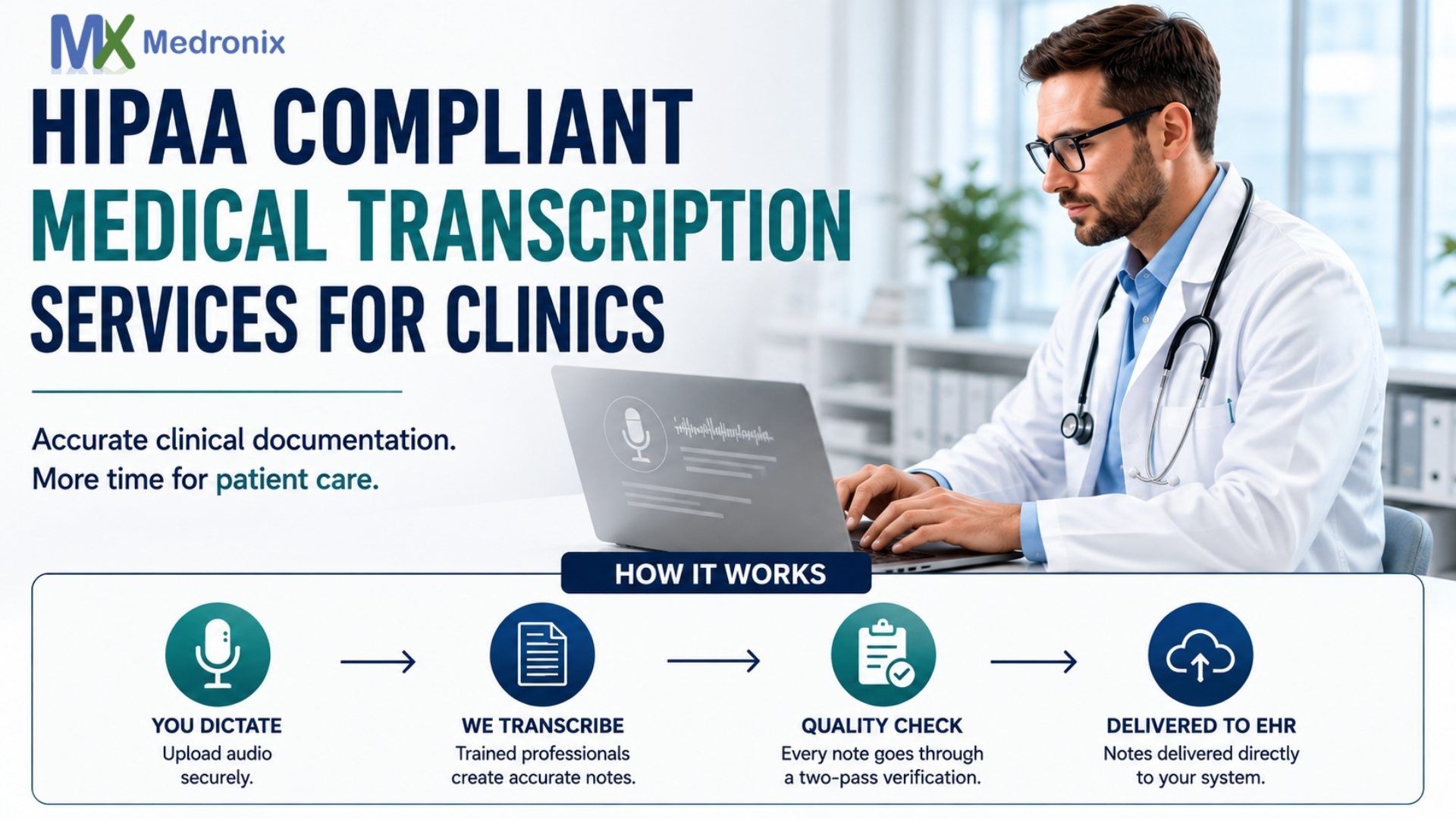
Speech-to-text tools have gotten better. But raw software still trips over accents, crossed voices, and dense clinical terms. That’s why the best medical transcription services pair AI drafts with trained human editors. They don’t swap out people for machines. They use both, together.
This mix catches errors that tools alone tend to miss. A misheard drug name. A cut-off sentence from a rushed voice memo. A two-pass check, where one person types the note and another checks it against the audio, is a strong sign. It tells you a provider treats accuracy as the top job, not a numbers game.
Integration is the other piece people forget, until it becomes a headache. A note that has to be copied by hand into an EHR defeats the whole point of outsourcing. Ask if the service links straight to Epic, Cerner, or eClinicalWorks. Ask how a finished note actually lands in a patient’s chart, and how many clicks that takes.
Plenty of practices still search for medical transcription services near me. They think a local vendor will be quicker to reach or easier to trust. In truth, location rarely decides quality anymore. Safe cloud tools let a focused team based anywhere ship notes just as fast, often more accurately, than a small local shop trying to cover every field at once.
What actually matters is speed and how well a provider talks to you, not a shared zip code. A provider that offers same-day or next-day delivery, plus a rush option for urgent dictations, will serve your practice better than a nearby vendor stuck with a three-day backlog. Ask how support requests get handled. Ask how fast a question about one note gets a reply. That quick reply tells you more than any street address ever could.
Not every provider fits every practice. A short comparison before you sign saves headaches later. Ask a handful of medical transcription service providers the same set of questions. What’s the normal turnaround time, and what does a rush job cost? How is the price set: per line, per minute, or a flat monthly rate? What fields do their staff actually cover, and can they show sample work?
It also helps to ask for a trial batch of real dictations before you sign a contract. A short trial shows more about accuracy, layout, and communication than any sales page ever will. Watch how the provider handles a rough audio file or an odd drug name during that trial run. That’s exactly what will happen during a busy week down the road, so it pays to test it early.
Keep a short scorecard while you run the trial. Note how long each file took, how many corrections your team had to make, and how the finished note looked once it landed in your system. A vendor that scores well on all three, speed, accuracy, and fit, is worth a longer contract. One that stumbles on even one point during a trial rarely improves once real volume kicks in, so don’t ignore small warning signs just because the price looks good on paper.
Notes shouldn’t be the reason a doctor stays late, or a practice manager loses sleep over risk. The right partner solves both problems at once. You get accurate, field-trained notes delivered fast, backed by the kind of security setup that protects patients and your practice’s good name alike.
Start small. Pick two or three vendors. Ask for a trial run, then compare how each one does on real dictations, not just sales claims. A provider willing to prove its speed and accuracy before you sign is usually the one worth keeping. If your practice is ready to see what a field-trained, HIPAA-compliant team can do, ask for a free trial and judge the results for yourself.
HIPAA compliant medical transcription services encrypt every file, sign BAAs, and train staff yearly to protect each patient record from exposure.
A medical transcription company blends trained human transcriptionists with technology, while software alone often misses context and medical nuance.
Most medical transcription services deliver standard files within twenty four hours, with rush or STAT options available in four to six hours.
Yes, reputable medical transcription services connect directly with Epic, Cerner, and eClinicalWorks so notes land in your existing workflow.
Location rarely matters now; secure cloud platforms let medical transcription services near me or overseas deliver equally fast, accurate results.
Medical transcription service providers usually charge per line or per minute, costing far less than hiring and training in house staff.