
Virtual Medical Scribing: How It Works for Your Practice
- medronix
If you’ve ever finished a full day of patient visits only to sit down at 7 p.m. and stare at a stack of unfinished charts, you already know the real cost of documentation. It’s not just the hours; it’s the energy you have left for your family and, honestly, for yourself. This is exactly the problem virtual medical scribing was built to solve, and if you’re wondering what it actually is and how it might fit into your practice, this guide walks through it in plain language.
What Is a Virtual Scribe, Really?
A virtual medical scribe is a trained documentation specialist who joins your patient encounters remotely, usually through a secure audio or video link and writes the clinical note in real time as you speak with your patient. Think of it as having an in-room scribe, minus the extra body in a small exam room and minus the overhead of hiring, training, and scheduling in-house staff. Medronix’s virtual medical scribing service is built around exactly this model, pairing your practice with a dedicated scribe rather than a rotating pool of strangers.
So what does a virtual medical scribe do, exactly? During the visit, they listen in (with the patient’s knowledge and consent) and capture the history, exam findings, assessment, and plan directly into your EHR template. Some scribes work purely by ear; others are supported by ambient AI tools that transcribe the conversation and flag key clinical details, which the human scribe then reviews and refines before it ever reaches your desk. The combination of a trained person and smart technology is usually what separates a good virtual scribing service from a mediocre one.
The Virtual Scribe Workflow is outlined step by step.
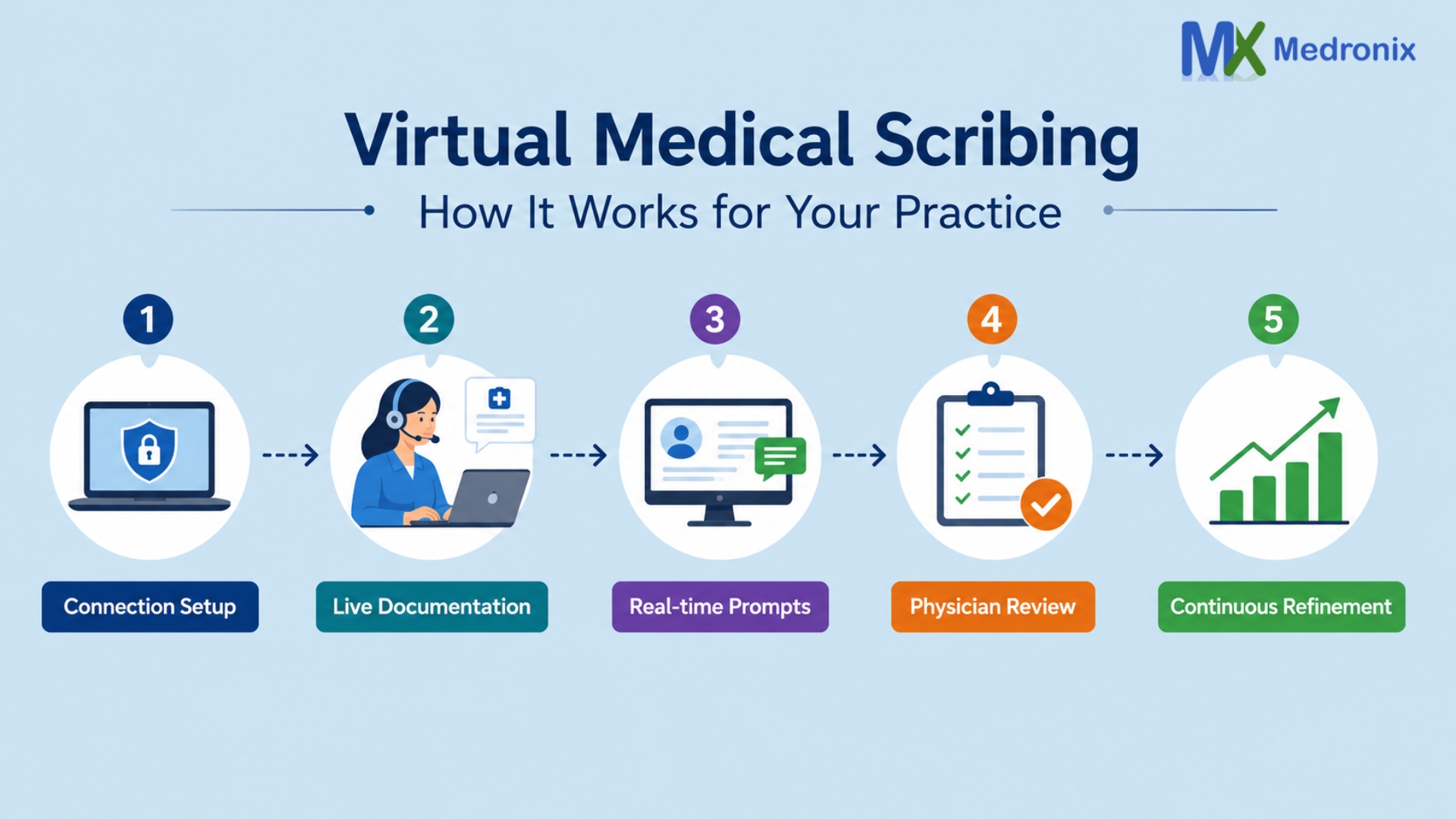
Understanding the virtual scribe workflow helps demystify what actually happens behind the scenes:
- Connection setup. Before your day starts, the scribe logs into a secure, HIPAA-compliant platform that links audio (and sometimes video) from your exam room to their workstation.
- Live documentation. As you examine and speak with your patient, the scribe types the encounter directly into your EHR: chief complaint, HPI, review of systems, exam, assessment, and plan following your specific templates and preferences.
- Real-time prompts. If something's unclear or a detail is missing, many scribes can flag it discreetly on a shared screen so you can clarify without breaking the flow of the visit.
- Physician review. Once the visit ends, you review the note, make any tweaks, and sign off. Because the note was built live, most charts are ready to close before the patient even leaves the building.
- Continuous refinement. Good scribing partners learn your voice, your shorthand, and your preferred phrasing over the first few weeks, so notes start sounding more and more like the way you'd write them yourself.
It’s not as important as people think that last point is. A scribe isn’t just transcribing words; they’re learning how you think through a visit.
Where AI Fits Into the Picture
A lot of practices ask about AI medical scribe patient interaction; specifically, does bringing AI into the room change how patients experience the visit? In our experience, when it’s introduced well, it barely registers. Patients are told upfront that a documentation specialist is assisting remotely, and most appreciate it, because it means their doctor is actually looking at them instead of a keyboard. The AI layer works quietly in the background, helping the human scribe move faster and catch details, but it’s the human review that keeps the note accurate and clinically sound.
The Real Benefits (Beyond "Saving Time")
The virtual scribe benefits most practices talk about are speed and same-day chart closure, and those are real. But a few other advantages tend to matter just as much once a practice has been using this virtual scribe system for a while:
- More patient encounters per day. Practices that stop typing during visits often find they can see meaningfully more patients without feeling rushed; some report 30% more encounters daily.
- Higher same-day chart closure rates. Notes finished during the visit mean far less after-hours charting. Same-day closure rates above 95% aren't unusual.
- Lower cost than in-house staffing. A virtual medical scribe eliminates the need for office space, equipment and full-time payroll overhead, typically reducing documentation costs by about 50% over hiring in-house.
- Less physician burnout. This is harder to put a number on, but it's often the benefit doctors mention first once they've adjusted to the workflow.
It’s not as important as people think that last point is. A scribe isn’t just transcribing words; they’re learning how you think through a visit.
A Quick Look: What This Looks Like in Practice
In a recent virtual scribe case study from a mid-sized family medicine practice, physicians who onboarded virtual scribing reported recovering close to two hours of documentation time per day, time that used to disappear into evenings and weekends. Same-day chart closure jumped from under 60% to nearly 98% within the first month, and providers described finally being able to make eye contact with patients again instead of splitting attention between the screen and the exam.
How to Choose the Best Virtual Scribe Platform
Not all virtual scribe platforms are created equal, and the differences count. When evaluating a service, it’s worth asking the following:
- Is the platform HIPAA-compliant, with clear data security protocols?
- Do the scribes know the style of documentation and the terminology used in your specialty?
- Do you have a human review the AI-assisted notes before they get to you, or is it AI alone?
- How does onboarding work, and how long before the scribe adapts to your preferences?
- What's the actual turnaround time for chart closure?
The right virtual medical scribe technology should feel invisible during the visit and dependable afterward, quietly doing the heavy lifting so you can focus on the person in front of you.
How Medronix Does Virtual Medical Scribing Differently
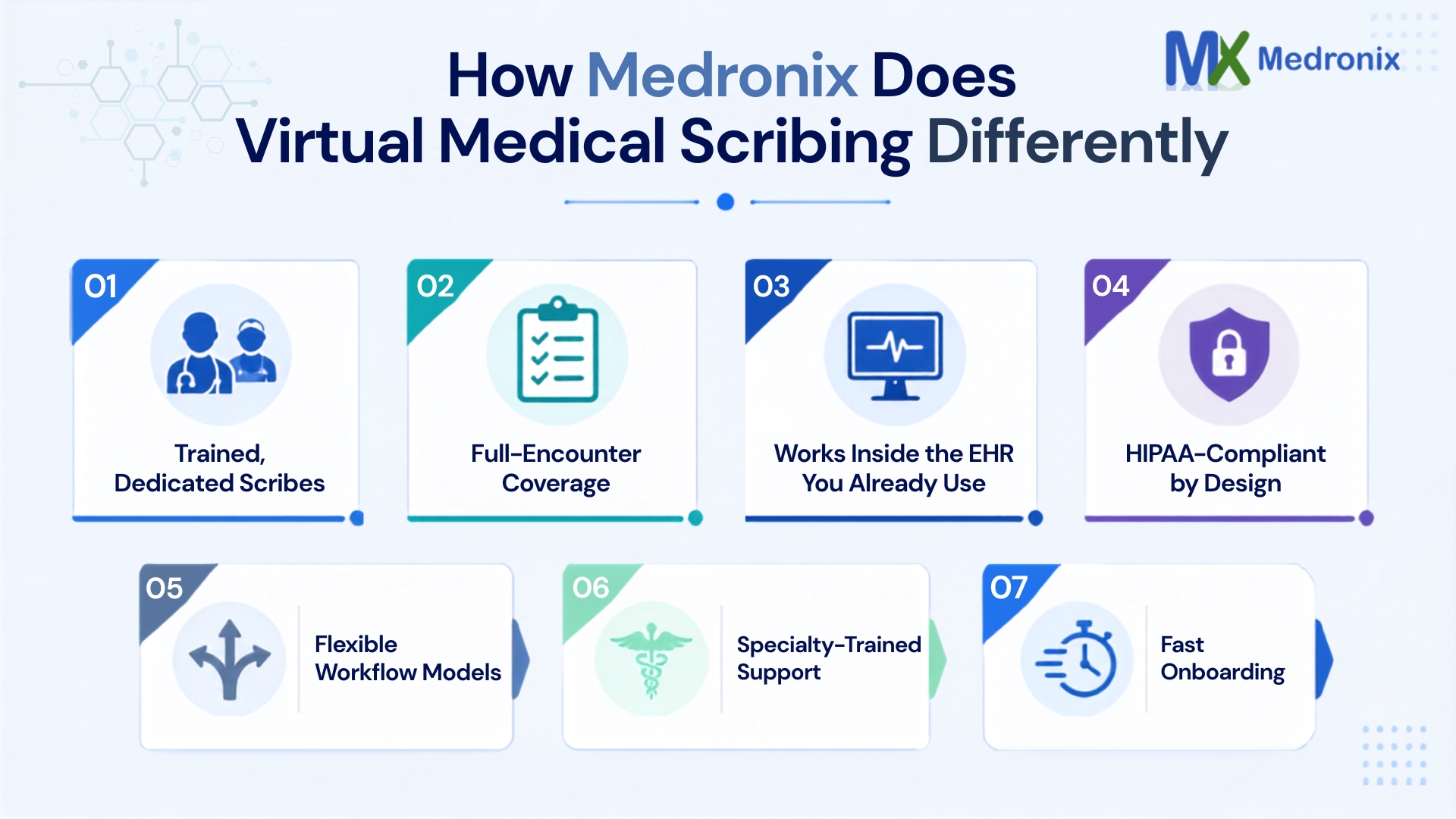
Plenty of companies offer a virtual scribe platform. Fewer build the workflow around your actual day, EHR, and specialty the way Medronix’s virtual medical scribing service does. In real life, that looks like this:
- Trained, dedicated scribes, not a rotating pool. Every physician is matched with a scribe who learns their documentation style, shorthand, and EHR habits over time, instead of starting from scratch with someone new each week.
- Full-encounter coverage. Chart pre-population before the visit, live capture of HPI, ROS, physical exam, assessment, and plan during the visit, plus orders, prescriptions, patient instructions, and referral letters handled before the patient walks out.
- Works inside the EHR you already use. Medronix's scribes document directly in Epic, athenahealth, eClinicalWorks, Cerner, NextGen, and more; no new software and no migration are required.
- HIPAA-compliant by design. Every virtual medical scribe is background-screened, HIPAA trained, and operates under a signed BAA with end-to-end encrypted connections. For telehealth visits, scribes never access patient video, so privacy stays fully intact.
- Flexible workflow models. Live, recorded, or post-encounter scribing or a mix so the virtual scribe workflow fits how your practice actually runs, not the other way around.
- Specialty-trained support. From primary care and cardiology to psychiatry, dermatology, orthopedics, and emergency medicine, scribes are matched to the terminology and documentation patterns of your field.
- Fast onboarding. Most practices are fully operational within a few business days, with trained backup coverage so your clinical day never skips a beat if your regular scribe is out.
If the virtual scribe benefits in this article sound like exactly what your practice needs, that’s the gap Medronix was built to close: real-time, accurate, EHR-native documentation, backed by a scribe who actually knows how you work.
Is It Time to Try It?
The documentation burden isn’t going away on its own, and most physicians didn’t go into medicine to become expert typists. Virtual medical scribing offers a practical middle ground: real-time, accurate notes, without the cost and complexity of building an in-house team from scratch.
If your evenings are still full of unfinished charts, it might be worth seeing what a real-time virtual medical scribe from Medronix could take off your plate one patient encounter at a time.
Frequently Asked Questions
Do I have to change how I talk during patient visits?
No. A good scribe adjusts to you, not the other way.
What happens if the scribe documents something wrong?
You will catch it during the review, just like any notes you would write.
For small, one-person practices, is virtual scribing worth it?
Yes, most of the time even more so because there is no backup charter.
Does virtual medical scribing work for telehealth visits?
Yes, the scribe joins audio only, with no video access.
How long before virtual scribing starts to feel normal?
About two to three weeks, then it feels seamless.
What if virtual scribing turns out not to be a fit?
That’s fair too, but most hesitation fades quickly.