
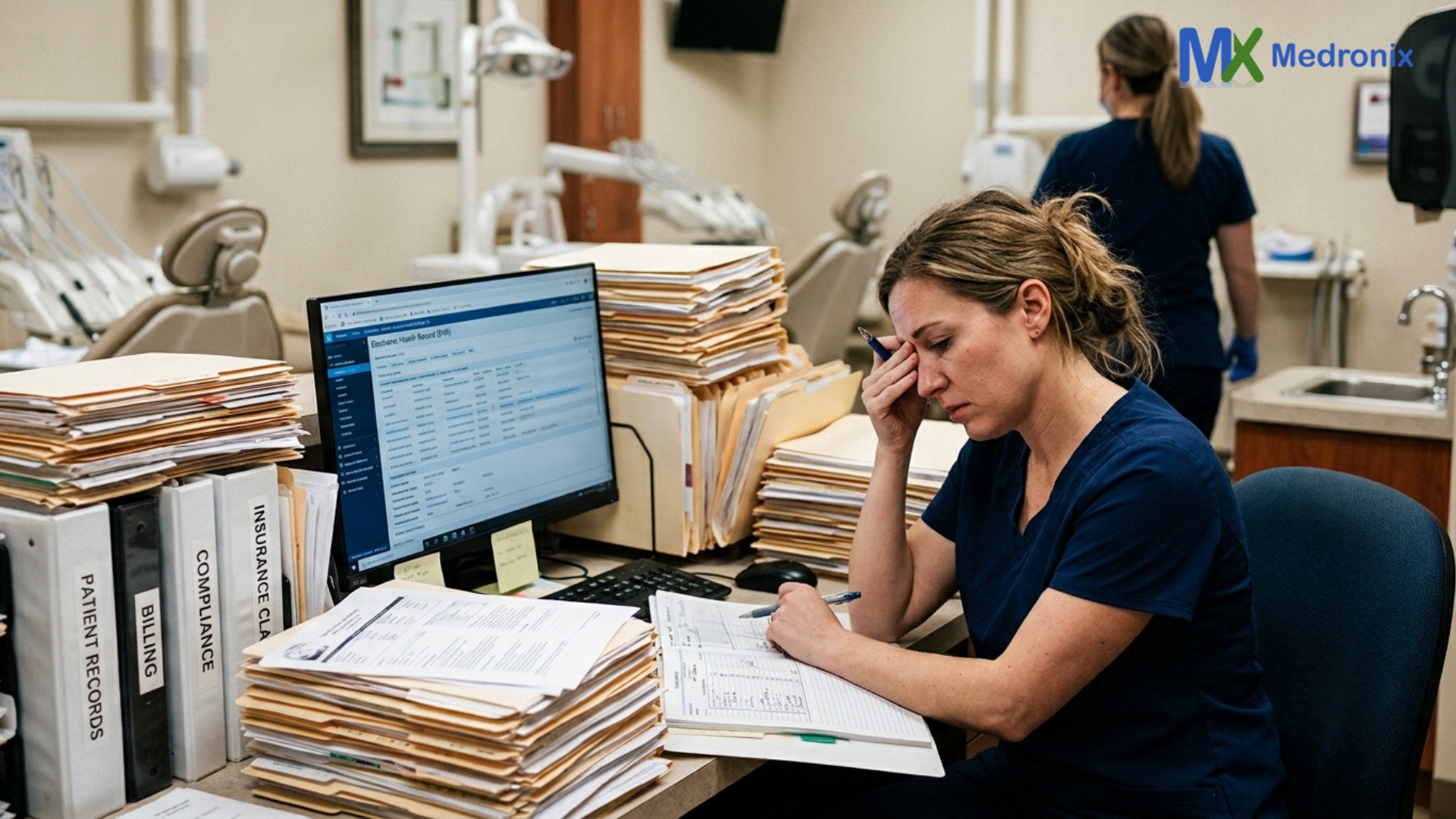
After a long day of seeing patients, fillings, root canals, and consultations, imagine having to stoop over your computer and type up clinical notes for two hours. The American Dental Association (ADA) did a poll in 2023 that found that dentists spend 34% of their workday on dull tasks like paperwork. This is in contrast to the time they spend directly treating patients. That means paperwork takes up more than three hours of work each week. This disparity is untenable for a profession that already faces high rates of burnout. Dental virtual medical scribes provide a strong, useful answer, and now is the time to embrace this technology before rivals do.
The paperwork problem in dentistry is more severe than most practitioners realize. A study from 2022, released in the Journal of Dental Education, found that dental professionals who spent more than 25% of their work hours on administrative tasks were 2.4 times more likely to be burned out than those who had fewer administrative tasks. Stressed dentists make more professional errors, use less staff, and provide a significantly inferior patient experience with all the ramifications it brings.
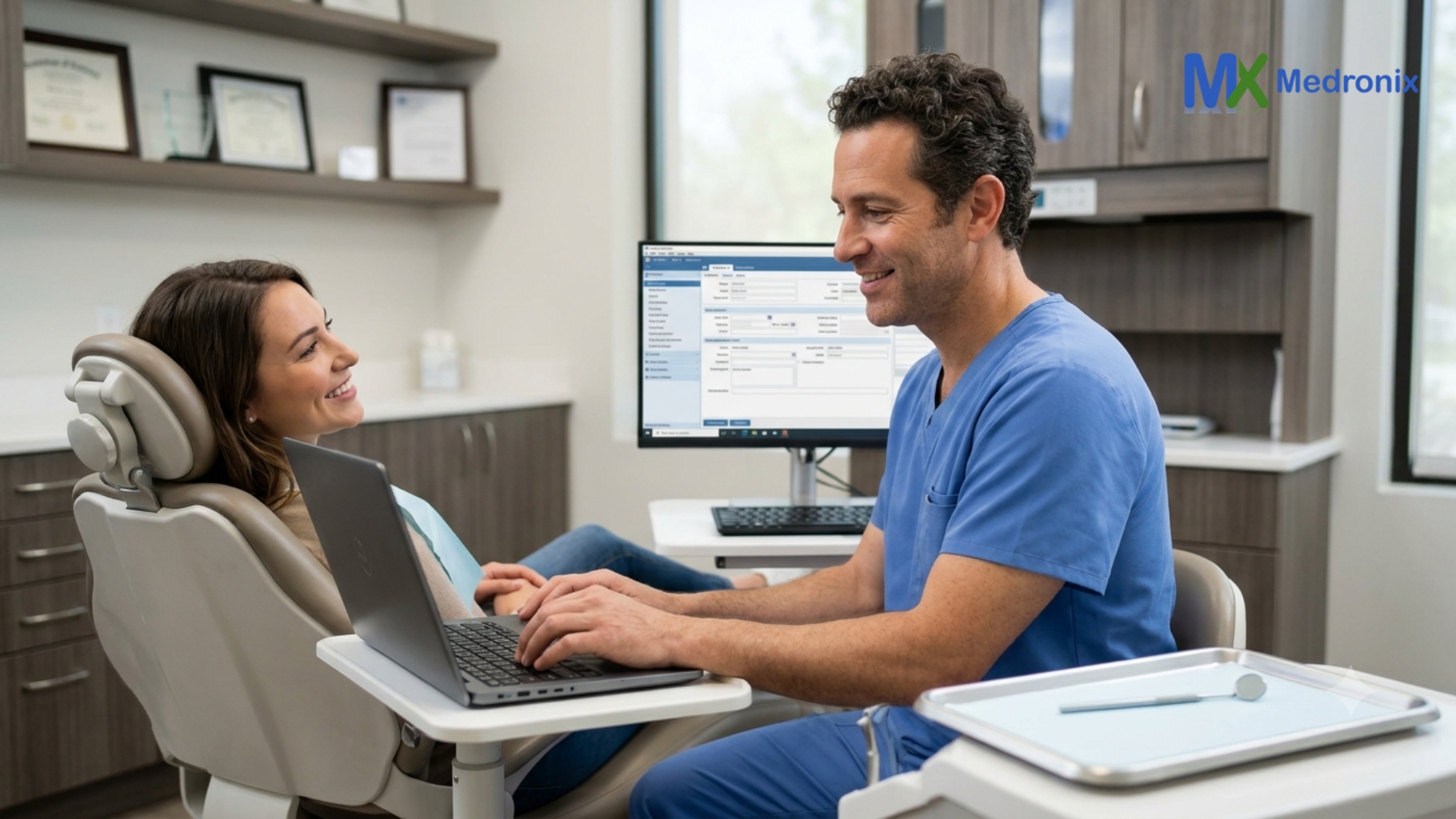
Here is a counterintuitive truth: when you free a dentist from documentation, patients get more, not less, of that dentist’s attention. Virtual scribe services allow dental practices to keep their providers face-to-face with patients throughout the appointment. They can make eye contact, describe procedures, and answer questions without trying to formulate notes in their head at the same time.
This research shift in the healthcare sector supports the use of virtual scribe services by experts in the health care field. A 2023 study in the Journal of General Internal Medicine found that doctors who used virtual scribes had 27% higher patient satisfaction and spent 19% less time with patients. This was done without altering the quality of the doctors’ notes. While the study focused on primary care physicians, dental practices that have piloted similar models report comparable gains.
Better treatment plan explanations When the dentist is not multitasking between talking and typing, explanations are clearer and patients ask better-informed questions, which leads to higher acceptance rates of treatment.
Faster post-appointment follow-up Because notes are complete immediately after each visit, the front desk can schedule follow-up appointments, issue referrals, and send post-care instructions before the patient even reaches the parking lot.
There is less time to wait.The American Association of Dental Office Management’s 2024 pilot statistics show that paperwork is being done at the same time, and dentists can move more quickly from room to room, so each patient has to wait up to 15 minutes less on average.
There are different service providers, and getting the wrong one can make things worse instead of better. How to Choose the Best Virtual Scribe Company for Your Dental Practice: 4 Things to Think About
HIPAA compliance and data security. Any virtual scribing arrangement involves the transmission of protected health information (PHI).Make sure they have a Business Associate Agreement (BAA) with the company and that all of their data and audio streams are end-to-end encrypted. When you hire a service you should always ask them to show you proof that they follow the laws.
General medical secretaries may not be familiar with dental terminology or problems like periodontitis, furcation involvement or periapical disease. Particularly if they have not had dental training. They may also not know how to use the dentist tools like Open Dental, Dentrix or Eaglesoft. Look for companies hiring virtual medical scribes that have trained people in dentistry and offer onboarding specific to the platform.
So back to it. For busy dental offices, notes have to be done in minutes, not hours. Learn how long it takes providers to turnaround notes on average and how they verify quality.
Scalability and flexible hours. Your busiest day might have 30 patients; a slow Tuesday might have 12. Choose a partner among the top virtual scribe services that can scale up or down without long-term contractual lock-ins, so you pay only for what you use.
Many practices start with a 30-day pilot, typically 5–10 hours of scribing per week, before committing to a full engagement.You can test the quality of the notes, the speed of staff response and the fit of the process with little financial risk.
The ROI Case: Virtual Medical Scribing Is an Investment, Not an Expense
But the cost of virtual scribing can make dental practice owners a little gun-shy. But if you flip the math from cost to ROI, the entire picture changes.
Think about, for example, a dentist who spends 90 minutes a day on documentation now. That’s $225 in lost productivity each day, based on the average dentist hourly rate of $150 (Bureau of Labor Statistics, 2024), or around $56,000 a year. A full-time virtual medical scribe service typically costs between $25,000 and $40,000 annually. The net savings, before factoring in recaptured revenue from seeing additional patients, range from $16,000 to $31,000 per year.
Now add the revenue upside. If a dentist can see just two additional patients per day with the time freed by scribing, and each patient generates an average of $250 in production, that’s $500 in daily added revenue, more than $120,000 per year at a five-day-per-week practice.
Virtual scribes for physicians and dentists also reduce the likelihood of costly documentation-related compliance penalties. The Office of Inspector General (OIG) has flagged improper dental billing linked to incomplete or inaccurate records as a growing audit target. Clean, scribe-generated notes reduce that risk considerably.
In summary, the financial argument is overwhelmingly in favor of using virtual scribes. The question is not whether dental practices can afford virtual scribes; it is whether they can afford to go without them.